
What should you look for when searching for traditional box braids near me? If you’re in Beasley, Texas, start by deciding what kind of braid pattern and finish you want. Traditional box braids begin with an anchored section at the root, while knotless braids start with your natural hair and add extension hair gradually. The two methods create different looks at the roots.
It’s understandable if you’re unsure how to describe your preferred size, length, or finish. At Bertha’s Image African Braids in Beasley, traditional Box Braids and Knotless Box Braids are both offered, giving you two distinct styles to consider. This guide explains the difference, helps you put your preferences into simple words, and covers what to prepare for your visit. Bring a reference photo if you have one, and think about whether you prefer a fuller or more delicate look. Braiding hair isn’t included with braid appointments, so plan to bring the hair you intend to use.
Key Takeaways
- When searching for traditional box braids near me, focus on a Beasley option and a braid look that suits your preferences.
- Describe the size, length, and overall effect you have in mind, and bring a reference image to help communicate your vision.
- Compare how traditional and knotless braids begin and look at the roots to decide which style appeals to you.
- Plan what to bring before your appointment. Braiding hair isn’t included with braid appointments.
- Bertha’s Image African Braids is based in Beasley and offers traditional Box Braids.
Traditional Box Braids Near Beasley, Texas: What the Style Involves
When you’re searching for traditional box braids near me in Beasley, Texas, start with the parting pattern. Traditional box braids are individual braids made from sections of hair divided into small, box-shaped parts. Each section becomes its own braid, creating a defined pattern across the scalp.
Unlike cornrows, which are braided close to the scalp in continuous rows, box braids hang freely as individual plaits. The size of the sections changes the overall effect: smaller sections create more individual braids, while larger sections make each braid more prominent. Length also affects the look, from shorter braids that sit closer to the head to longer, more noticeable plaits.
Traditional box braids generally begin with an anchored section at the root. Knotless braids use a different starting method, adding extension hair gradually as the braid is formed. The methods create distinct root appearances, so consider which one you prefer. For background on the style’s roots and broader meaning, explore this overview of the history and cultural significance of box braids.
What makes traditional box braids different?
Look at the scalp: the defining feature is a grid of separate sections, with one braid emerging from each part. That visible structure gives traditional box braids their individual-braid character. Knotless braids also appear as separate plaits, but they’re built gradually from the natural hair rather than starting with the same anchored base. If the root appearance matters to you, use it as one of your main comparison points.
Who might be drawn to this classic braid style?
You may be drawn to traditional box braids if you like a defined pattern of individual plaits and want to choose the overall look through braid size and length. Think about your everyday routine, too. Do you prefer braids that frame your face, hang longer, or feel less prominent? Consider what you enjoy seeing in the mirror and how you usually style your hair. Comfort matters alongside appearance.
You don’t need technical language to explain what you like. A reference image can show the parts, braid thickness, and length you have in mind. You can also use simple descriptions, such as “more visible sections” or “a fuller-looking braid pattern.” These details give your stylist a practical starting point for discussing the look you want.
Bertha’s Image African Braids is a professional braiding salon based in Beasley, Texas, offering traditional Box Braids. Picture the style that suits your day-to-day life: the parting pattern, a comfortable length, and an overall look that feels like you.
Choosing Box-Braid Size, Length, and Look for Your Beasley Appointment
Once you have a style in mind, turn it into a few clear preferences. You don’t need salon terminology. Simple descriptions and a useful reference photo can help you explain what you want. For traditional box braids near me in Beasley, focus on the look you’re aiming for and the details that matter most to you.
Size and length both shape the overall effect. Smaller braids create a finer, more detailed appearance, while larger braids make each plait stand out more. A shorter length sits closer to the head; longer braids create a different visual line and presence. Think about how you want the finished style to look, rather than relying on a size or length label alone.
How to describe the braid size and length you prefer
Start with everyday words. You might say you like a delicate braid pattern, or that you’d prefer each braid to look fuller and more defined. For length, describe where you’d like the braids to fall, such as around your shoulders or farther down your back. These descriptions give a clear starting point without requiring technical labels.
Then consider the whole picture: how visible you want the braids to be, the length you have in mind, and what feels comfortable for your routine. Braid size and length change how much the finished style stands out. Focus on the effect you’re drawn to and explain it plainly.
How to use inspiration photos thoughtfully
A reference photo can make your preferences easier to explain. Choose a clear image, then identify what you like most: the braid thickness, length, visible parts, or the way the style frames the face. Naming one or two details is often more useful than trying to reproduce every feature in a picture.
Use photos as a guide, not a promise of an exact replica. Hair and personal preferences differ, so stay open to adapting the reference. You might say, “I like this length, but I’d prefer a fuller-looking braid,” or point out the one detail you most want to carry into your own look.
The three useful choices to discuss are size, length, and overall look. Before your appointment, jot down a few notes or save a reference image on your phone. That way, you can explain what matters most to you without having to remember every detail.
- Size: Finer and more detailed, or fuller and more noticeable.
- Length: Where you’d like the braids to fall.
- Overall look: The visual effect you want for everyday wear.
To see the braid styles offered in Beasley, browse Bertha’s Image African Braids services. Save an example that appeals to you and note the details you’d like to discuss.
Traditional vs. Knotless Box Braids: A Practical Beasley-Area Comparison
Traditional and knotless box braids are both made as individual plaits, but they begin differently. If you’re looking for traditional box braids near me in Beasley, compare how each braid is constructed and how the roots look. Neither method is right for everyone; your preference is the useful guide.
How the braid-starting methods differ
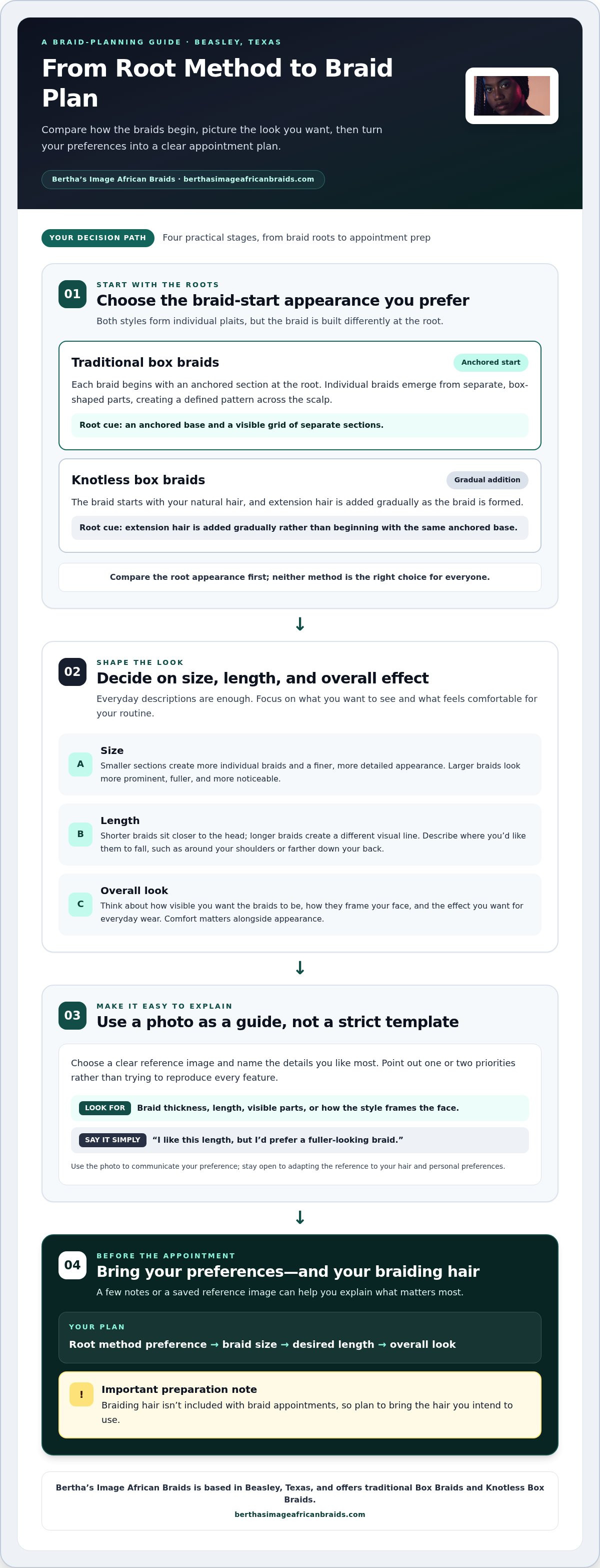
Traditional box braids generally begin with an anchored section at the root. With knotless braids, the braider starts with the natural hair and gradually feeds in extension hair as the braid takes shape. Traditional braids begin with an anchored section, while knotless braids are built by gradually adding hair. This describes how the braids are constructed. It does not guarantee a particular result for comfort, weight, wear, or hair outcomes.
| What to compare | Traditional box braids | Knotless box braids |
|---|---|---|
| Starting method | Generally begin with an anchored section at the root. | Extension hair is gradually added as the braid is formed. |
| Visible appearance | The starting point may be more noticeable, with individual braids and parted sections defining the pattern. | The braid begins more gradually at the root, creating a different-looking start. |
| Preference to consider | Whether you like a clearly anchored beginning and a defined braid pattern. | Whether you prefer a gradual braid start and its distinct root appearance. |
Which style better matches your preferences?
Think about the construction you prefer at the roots, then consider how you want the finished braids to look overall. A reference image can help you point out the details you’re drawn to, but your choice doesn’t need to follow a trend. Personal preference matters, as does feeling comfortable with the style you’ve chosen.
For a simple comparison, ask yourself:
- Do I prefer a braid that begins with an anchored section or one built up gradually?
- Which starting appearance feels closer to the look I have in mind?
- Am I choosing this style because it suits me, rather than because it’s popular?
At Bertha’s Image African Braids in Beasley, Texas, both Box Braids and Knotless Box Braids are offered as distinct style options. Use the difference in starting method to explain what appeals to you, then describe the finished look you’re hoping for. A clear preference gives the conversation a helpful place to begin without assuming one method will feel or perform the same for everyone.
How to Prepare for Traditional Box Braids in Beasley
A little preparation can make it easier to explain the style you have in mind. Choose your preferred overall look, gather a reference or two, and plan what to bring. You don’t need to decide every detail in advance. A few clear preferences are a useful place to begin.
What to decide before your appointment
Picture how you’d like your traditional box braids to look in everyday life. Consider the braid size and length you prefer, along with the overall effect you’re drawn to. You might like a more noticeable braid pattern, a finer-looking set of braids, or a length that suits your usual routine. These preferences help describe the look you want.
Next, save one or two reference photos that show the style clearly. Choose images that help explain what you like rather than collecting a large set with conflicting details. If one photo shows the size you prefer and another gives a better sense of length, make a note of that. A picture can guide the conversation, but it can’t promise an exact replica. Your hair and preferences are part of the final discussion, too.
If you’re still deciding, write down a few notes in plain language before you go. For example: “I like this braid size, but I’d prefer a different length.” That makes it easier to explain what you want without needing technical terms. A few notes are enough to get the conversation started.
What to bring and how to plan
One practical detail is easy to overlook: braiding hair is not included with braid appointments. Plan to bring the braiding hair you intend to use. Keep it together with any reference photos or notes, so the items that help communicate your preferences are ready in one place.
A simple checklist can keep your preparation clear:
- Choose the overall look you want to discuss.
- Gather one or two photos that show the details you like.
- Think through your preferred braid size and length.
- Plan to bring the braiding hair you intend to use.
If you’re looking for traditional box braids near me in Beasley, Bertha’s Image African Braids offers traditional Box Braids. Explore traditional Box Braids and bring your preferences along as you plan.
Find Traditional Box Braids Near You at Bertha’s Image African Braids
If you’re searching for traditional box braids near me in Beasley, Texas, Bertha’s Image African Braids is a professional braiding salon based in the community. Traditional Box Braids are offered here. Bring the style preferences you’ve been considering to guide a clear conversation about the look you want.
A local braiding service with styles to explore
Traditional box braids are the focus of this guide, but they’re not the only style you can explore. Bertha’s Image African Braids also offers Knotless Box Braids, twists, cornrows, crochet, and loc services. Each is a distinct style or service with a different look to consider if your preferences change.
You don’t need to choose from every possibility. If the defined appearance of traditional box braids appeals to you, let that be your starting point. If you’re weighing styles, compare the traditional and knotless braid starts and think about which root appearance you prefer. A reference photo can help you show the details that catch your eye.
Your next step toward a braid appointment
Gather the details that will make it easier to share your vision. Think about the overall look you prefer, the size and length you have in mind, and which details matter most. Save one or two reference photos, remembering that an image is a guide rather than a promise of an exact replica. Your preferences can shape the conversation while leaving room to discuss the details.
Plan for the practical detail, too: braiding hair is not included with braid appointments. Bring the hair you intend to use. A simple note on your phone can keep your style preferences, reference images, and reminder to bring hair together.
- Settle on the overall look you want to discuss.
- Gather a reference image or two and note the details you like.
- Plan to bring the braiding hair you intend to use.
With your preferences gathered, you have a clear starting point for choosing a style. If traditional Box Braids feel right, explore Bertha’s Image African Braids services and take the next step toward your Beasley appointment.
Take the Next Step at Your Own Pace
You don’t need to have every detail settled before choosing a braid style. Let your preferences be a starting point. As you look for traditional box braids near me, consider how you want the style to frame your face and feel in your day-to-day routine.
A thoughtful appointment begins with a simple exchange: you share what you’re drawn to, and your stylist can discuss the look you’ve chosen. Bring the ideas you have, even if they’re still taking shape. Choosing a style with care can be more useful than rushing toward a trend.
Bertha’s Image African Braids offers traditional Box Braids in Beasley. Explore traditional box braids and take the next step toward your appointment.
Frequently Asked Questions
What are traditional box braids?
Traditional box braids are individual plaits formed from hair divided into separate sections. They can be worn in different lengths and sizes, so the final look depends on the preferences you share. If you’re searching for traditional box braids near me, start by deciding whether you like a clearly defined pattern of separate braids. A saved photo can help show the overall effect you have in mind.
Are traditional box braids and knotless braids the same?
No. They’re both individual braid styles, but the braiding process begins differently. Traditional box braids generally start with an anchored section, while knotless braids are built by adding extension hair gradually. That difference affects how the roots appear, but it doesn’t make one option universally better. Consider which starting look you prefer, then share that preference when discussing your style.
Can I get traditional box braids if my hair is short?
Short hair doesn’t automatically rule out box braids, but suitability depends on your hair and the look you’re hoping to achieve. Consider how much of your natural hair you want showing and whether you’re comfortable with the finished braid length and appearance. The stylist can assess your hair in person and discuss what may work for your situation. A photo alone can’t predict the result.
How long do traditional box braids last?
There isn’t one set wear time that applies to everyone. How long your braids remain looking and feeling right can vary with your hair, the way the style is maintained, and how much new growth appears. Pay attention to changes rather than following a rigid calendar. If the roots become difficult to manage, the braids feel uncomfortable, or your hair is tangling, consider taking the style down.
Do I need to bring braiding hair to my appointment?
Yes. Braiding hair isn’t included with braid appointments, so plan to bring the hair you intend to use. The hair used for one style may differ from another. If you’ve saved a reference photo, keep it with your hair so you can use both to explain the braid appearance you’re aiming for.
Can traditional box braids be styled in different sizes?
Box braids can be created in different sizes as a general style choice. A finer braid pattern shows more individual plaits, while larger braids make each plait more prominent. Instead of relying on a label alone, describe the visual effect you like. A clear reference image can help communicate that preference.
Are box braids automatically a protective style?
No, the name of a style alone doesn’t guarantee that it will protect your hair. The result depends in part on how the braids are installed and cared for, as well as how your own hair responds. Speak up if the style feels uncomfortable, and avoid treating tightness as something you must tolerate. Thoughtful installation and attentive care matter alongside the choice of braids.